




Transformation of Winter Harbour
One of the most significant sites in Bratislava - Winter Harbour - is about to change. The Metropolitan Institute of Bratislava has prepared a vision for its transformation, commissioned by the site owner, the state-owned company Public Port. International masterplanning competition, has been announced on 23rd February.

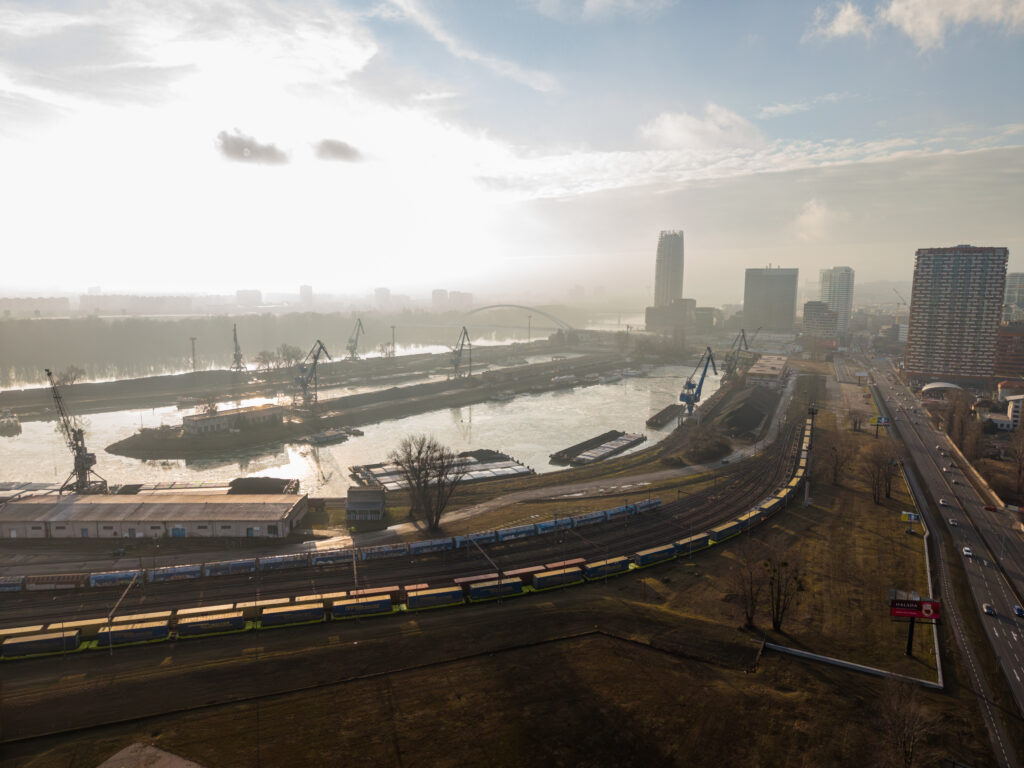
The Winter Harbour is a historically significant industrial area of Bratislava, covering approximately 65 hectares, with several protected heritage structures. It currently operates as a cargo harbour on the Danube and is located in close proximity to the rapidly developing Mlynské nivy district.
Story of the Harbour
The Bratislava Winter Harbour was in its time among the largest ports on the Danube in the Kingdom of Hungary and was established as a result of the river regulation of the Danube between 1886 and 1896.
The construction of the port in 1897 was linked to the development of the industrial district and the railway infrastructure, which is still present there today.

The character of the Harbour changed during and between the world wars and the transport began to decline after 1989, when river transport was largely replaced by road and rail freight.
In recent years, however, its capacity has not been fully utilised. Today, the port operates at approximately 25% of its capacity and awaits its renewal. For this reason, the state — represented by the Ministry of Transport of the Slovak Republic and the Public Port — has taken a strategic decision regarding the future development of this area. “The concentration of transshipment capacities in the ,Pálenisko´ area was a strategic decision by the state aimed at more efficient harbour operations and freeing up the Winter Harbour for new urban development. This step creates the conditions for transforming a currently closed area into a fully functional and accessible part of Bratislava. We see the vision as an important professional framework for further decision-making about the future of this site,” says Matej Danóci, CEO of Public Port.
The Chief City Architect of Bratislava, Juraj Šujan, highlights the importance of the area: “The Winter Harbour is a unique location close to the city centre that should become an integrated and accessible part of it — a district with high-quality infrastructure and a direct relationship to the river.”
Time for a change
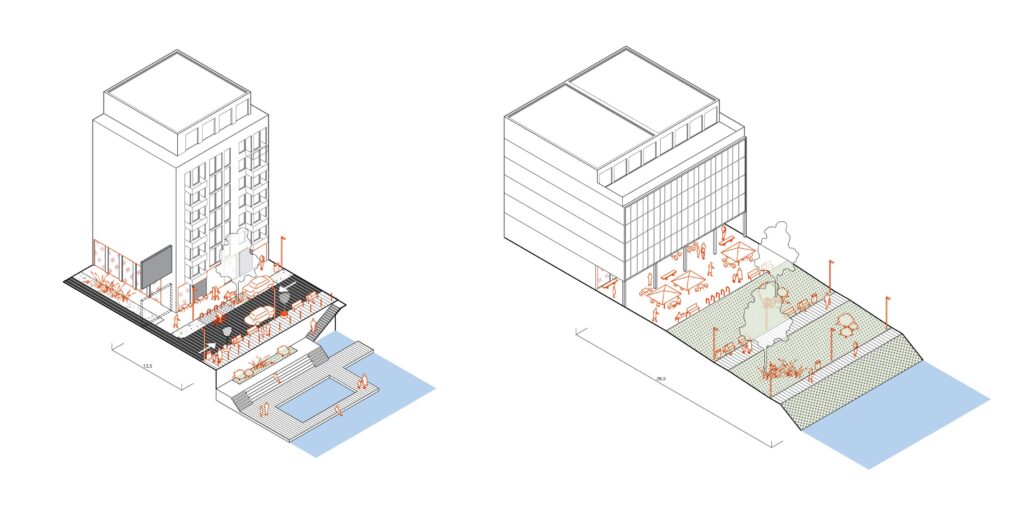
The first step towards transformation of Winter Harbour is the Vision for the Development of the Winter Harbour Area. The document was developed over more than a year in cooperation with experts, public institutions and international specialists. Its aim was to verify the urban, technical, economic and environmental feasibility of the transformation, including flood protection measures and the preservation of heritage assets. “During the preparation of the vision, we carried out surveys and analyses and developed an initial concept, which was subsequently consulted with key stakeholders and experts. After collecting feedback, this concept was refined into its final form,” explains Daniel Tomko, urban planner of the Metropolitan Institute of Bratislava.
Based on the client’s request, the resulting comprehensive document will also serve as a basis for preparing Amendments to the City’s Land Use Plan, given that the project represents a strategic state investment. “The vision defines the framework for what a vibrant part of the city in the Winter Harbour should look like. The task is to establish principles for future development—creating an open and accessible waterfront district with high-quality public spaces, greenery, and respect for the site’s industrial history. Examples from the transformation of other European harbours show that long-term professional consensus on these principles is crucial,” explains the vision’s expert guarantor, architect Peter Gero, a co-author of a comparable district in Hamburg.
International competition as the next step
The vision was directly followed by an international, two-stage masterplanning competition, the outcome of which will be a comprehensive masterplan for the area.
The competition has been announced on 23rd February 2026 by the Public Port and the City of Bratislava, organized by Metropolitan Institute of Bratislava. The expert jury consists of internationally respected architects with experience of waterfront transformations across European cities. First-stage submissions are due till end of May 2026.
“The competition presents a unique opportunity to reconnect Bratislava with its waterfront and to redefine the relationship between city center, the river and the natural environment,” said Paco Bunnik, jury member and Chief Urban Designer of the City of Amsterdam.
Catherine Burd, British architect and the jury co-chair underlined, that “the redevelopment of this dockland site in Bratislava is a chance to create a people-centred, ecological urban quarter for the young, outward-looking and rapidly expanding capital city. This ambitious competition encourages teams to reimagine what is perhaps the last undeveloped industrial dockland site in a European capital, and to play a key part in shaping the city’s future”.
The design brief calls for multidisciplinary teams with expertise in masterplanning, urban design, heritage, landscape and placemaking, supported by technical, environmental and economic insight, to respond to the site’s unique spatial, cultural and natural conditions. While inspiration may be drawn from successful European harbour transformations, proposals must be rooted in Bratislava’s specific character, history and landscape.
“The aim is not to replicate existing models, but to create a distinctive urban district authentic to the Winter Harbour and unmistakably rooted in its context,” explains Petra Marko, CEO of the Metropolitan Institute of Bratislava.
The competition itself will not mark the end of the process—after both rounds are evaluated, the masterplan will be further refined based on feedback and elaborated through smaller-scale projects.
Inspiration from European waterfront cities
In preparing the vision, Bratislava studied examples of European cities that have successfully transformed former harbour and industrial areas—such as Hamburg (HafenCity), Amsterdam, Malmö, and Copenhagen (Nordhavn). Representatives of the Metropolitan Institute of Bratislava, the city, and the harbour authorities visited these cities or consulted with their representatives. Architects from Amsterdam and Malmö also visited Bratislava and its harbour.
The shared lessons from these examples show that successful transformations are characterised by a long-term process, strong public regulation, a focus on public spaces and cultural functions, and the preservation of local identity.
There are few national cultural monuments, including the Seamen’s House (1940), the Art Nouveau pumping station building (1904), the oldest preserved vessel in Slovakia—the tugboat Šturec (1937), the ship lift (1940), and the two oldest cranes. Other valuable structures include warehouses, the ship repair workshop, the harbour basins themselves, and remnants of the railway infrastructure. “The Winter Harbour is not an ordinary brownfield. It is a place with a unique history, a strong relationship to the Danube, and significant technical heritage structures. These qualities should become the foundation of the new district, not an obstacle to its development,” underlines Petra Marko, CEO of the Metropolitan Institute of Bratislava.


A long-term process aiming for public consensus
Representatives of the city and the harbour emphasise that the transformation of the Winter Harbour is a long-term, phased process that requires time, expert preparation and coordination between the public and private sectors.

The first step is reaching an agreement on what kind of urban district should emerge in the area. The ambition is to create a modern, mixed-use, accessible and climate-resilient district with high-quality public spaces—one that naturally extends Bratislava’s city centre, opens the Danube riverbank to the public, and preserves the unique industrial genius loci of the Winter Harbour and its heritage structures for future generations.

Public Participation
As part of the process of international competition, the Metropolitan Institute of Bratislava also led a broad public participation process to understand how Bratislava residents imagine the future of Winter Harbour.
Nearly 800 Bratislava residents took part in the participation process. In April and May, they were able to share their views during guided walks through the otherwise closed port area, in person through focus groups at TU-BA, or via an online questionnaire. The public agreed that they imagine Winter Harbour as a lively, recreational, green, accessible and authentic district with high-quality public spaces for everyone.
Among the most frequently discussed topics were better access to the water and its use, preservation of the area’s industrial character, more greenery and shade, safe movement on foot and by bicycle, a representative cultural venue, opportunities for water sports and other less traditional sports, friendly community spaces, and accessible services for future residents and visitors.
Some residents would like to see Winter Harbour become the centre of a true metropolis, with representative public spaces and high-rise buildings. Others would prefer this section of the riverfront to retain a wilder character, with lower-rise development. At the same time, the public expressed concerns that the area could become too elitist, commercial or closed-off, with monotonous or overly dominant architecture.
The participation report summarises the needs, expectations and concerns of Bratislava residents. Its purpose is to ensure that the final proposals in the current round of the competition respond not only to expert and technical requirements, but also to the ideas of the people who will use the future public spaces.